

In this article, you’ll see examples of how to meaningfully use Blippit Boards’ framework tag categories to capture the depth of the school curriculum, using them to share impact, spark/support reflection, and strengthen your professional conversations.
Tip!
Toggle 'on' the new categories in the app tag settings ⚙️ Each of the new tag categories is labelled with a jigsaw icon 🧩 to make them easy to find and activate all seven. We have renamed two categories to include them in this family of tags and Blippit now offers
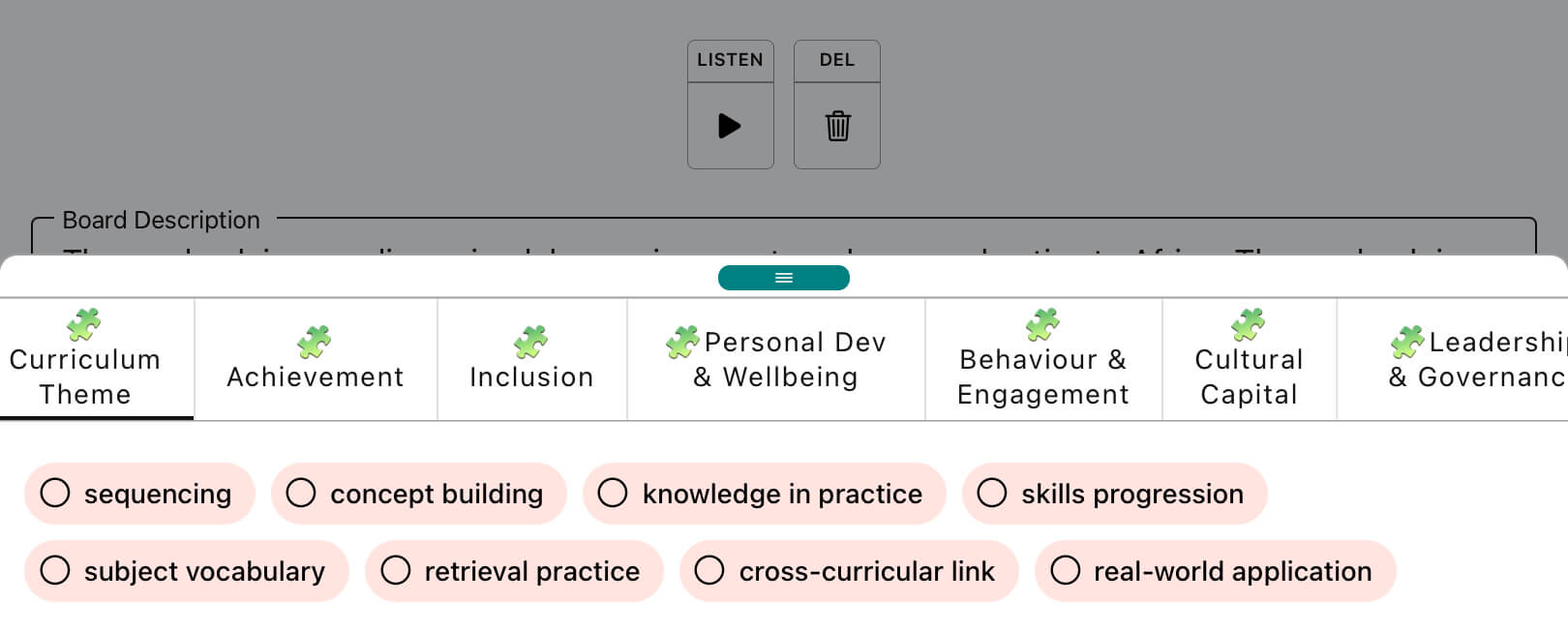
How to find and activate hidden categories
Context: A Year 4 teacher and science lead create a board capturing how pupils explore habitats in their school garden.
🏷 Tags applied:
Curriculum Theme (concept building, real-world application), Inclusion (adaptive teaching), Achievement (developing → secure), Personal Development (curiosity, teamwork). Incl: ks2, yr4, science and so on.
This board shows curriculum intent and impact through real experiences, not forms.
Context: A Year 6 teacher documents pupils’ progress across a writing unit.
🏷 Tags applied:
Achievement (emerging, secure, greater depth), Curriculum Theme (skills progression), Leadership (Professional Development). Incl: ks2, yr6, english,writing and so on.
Demonstrates progress as a journey that is rich, visual, and authentic.
Context: A KS1 teacher captures how adaptive teaching helps every child share their ideas confidently.
🏷 Tags applied:
Inclusion (total communication, assistive tech), Curriculum Theme (subject vocabulary), Personal Development (confidence). Incl: ks1, yr1, yr2 and so on.
Shows inclusion as everyday practice, not policy paperwork.
Context: A PSHE lead curates moments from a whole-school kindness initiative.
🏷 Tags applied:
Personal Development (empathy, responsibility), Behaviour & Engagement (positive conduct), Cultural Capital (community involvement). Incl: ks1,ks2,pshe and so on.
Makes invisible values visible through lived wellbeing, not a checklist.
Context: A PE lead explores collaboration and perseverance through team games.
🏷 Tags applied:
Behaviour & Engagement (participation, self-regulation, focus & perseverance), Personal Development (teamwork). Incl: ks1, ks2, pe and so on.
Captures positive conduct as something learned, not enforced.
Context: A history lead showcases how pupils connect local heritage to the wider curriculum.
🏷 Tags applied:
Cultural Capital (local heritage, community involvement), Curriculum Theme (cross-curricular link). Incl: ks2, history and so on.
Shows enrichment as belonging and relevance, not extras.
Context: A subject leader brings together evidence showing how the maths vision lives in classrooms.
🏷 Tags applied:
Leadership & Governance (Curriculum Leader, Subject Action Plan), Achievement (greater depth). Incl: ks1, ks2, maths and so on.
Supports professional dialogue and trust collaboration without adding workload.
| Blippit Boards Tag Category 🏷 | Corresponding Ofsted 2025 Evaluation Area(s) | Contribution / Focus |
|---|---|---|
| Curriculum Theme | Curriculum & Teaching | Captures how curriculum intent, implementation, and impact are demonstrated through classroom evidence. |
| Achievement | Achievement | Links to pupil progress and attainment outcomes, showing evidence of learning over time. |
| Inclusion | Inclusion | Shows how the curriculum and wider provision meet the needs of all learners, including SEND and disadvantaged pupils. |
| Personal Dev & Wellbeing | Personal Development & Well-being | Highlights pupil character development, resilience, independence, and overall wellbeing. |
| Behaviour & Engagement | Attendance & Behaviour (Behaviour and Attitudes) | Reflects pupils’ engagement, conduct, perseverance, and collaboration in learning. |
| Cultural Capital | Personal Development & Well-being (Enrichment strand) | Demonstrates how schools build cultural awareness, enrichment, and preparation for life and work. |
| Leadership & Governance | Leadership & Governance | Captures senior and subject leadership actions, planning, professional development, and oversight. |
Reference: Education Inspection Framework (for use from November 2025), Department for Education & Ofsted. View framework.