
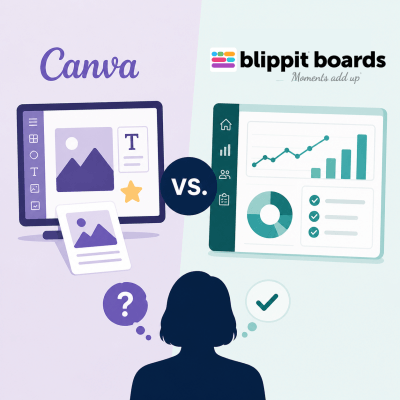
A headteacher told us recently that their school had stopped using Blippit Boards. They were using Canva instead. It was free, and staff were finding it easier.
We didn’t argue. We said thank you and wished them well.
But we’ve thought about that conversation a lot since - not defensively, but because it’s something we hear in different forms across schools. And it tends to point to something important about how decisions get made under pressure.
In our experience, decisions like this aren’t really about comparing tools side by side.
They’re usually a response to a set of very real pressures: staff workload, familiarity, budget, and the need to keep things moving without adding friction.
When someone says, “we’re using Canva instead,” it’s rarely a precise claim about functionality. It’s usually a shorthand for something else.
Across schools, it tends to be some combination of these.
Sometimes a tool like Blippit can feel structured in ways that create friction - especially when staff are already stretched.
Canva doesn’t ask you to think about curriculum, or monitoring, or reporting. You open it, drop something in, and you’ve got a finished output. That immediacy matters.
If that’s part of the picture, it’s useful feedback. A tool that isn’t being used consistently - for whatever reason - isn’t doing its job.
Sometimes it’s simpler than that. Canva for Education is free. Blippit isn’t. In the current climate, that’s a completely reasonable factor in decision-making.
Where it becomes more complex is when the comparison quietly assumes the tools are doing the same job - because that’s where things can start to drift.
This is the most interesting one.
There’s a body of research - Gary Klein’s work on recognition-primed decision making is a good example - that shows experienced professionals don’t tend to analyse every option in detail. They recognise patterns.
Canva fits a pattern that’s already familiar:
teachers know how to use it, it produces something tangible, and it looks like evidence.
All of those are valid signals.
But the pattern being matched is usually:
“a place where teachers can capture and present what’s happening”
Which isn’t quite the same as:
“a way of understanding how the curriculum is actually working across the school”
Those are different problems. They just happen to look similar at first glance.
Most schools would say that curriculum quality is a priority. That’s consistent across inspection frameworks, leadership conversations, and day-to-day practice. But over time, systems tend to shape what’s visible.
And what we often see is this:
the system starts reinforcing what’s easiest to capture - rather than what matters most.
It’s a very natural place to land when time, budget, and staff energy are all under pressure, rather than a poor decision.
But it does change what leaders can actually see. A well-designed page of photos from a lesson looks like strong evidence. What it doesn’t show is whether that lesson sits within a coherent sequence, whether learning is building over time, or whether subject leaders have visibility beyond their own classrooms.
So the school ends up with outputs that look like evidence - without always having the insight that sits behind it.
Canva is excellent at what it’s designed to do.
It helps teachers create clear, engaging outputs. It’s accessible, familiar, and quick to use. In many contexts, that’s exactly what’s needed.
But it isn’t designed to answer questions like:
At some point, many schools realise they need something that goes beyond creating and presenting evidence - something that helps them understand it.
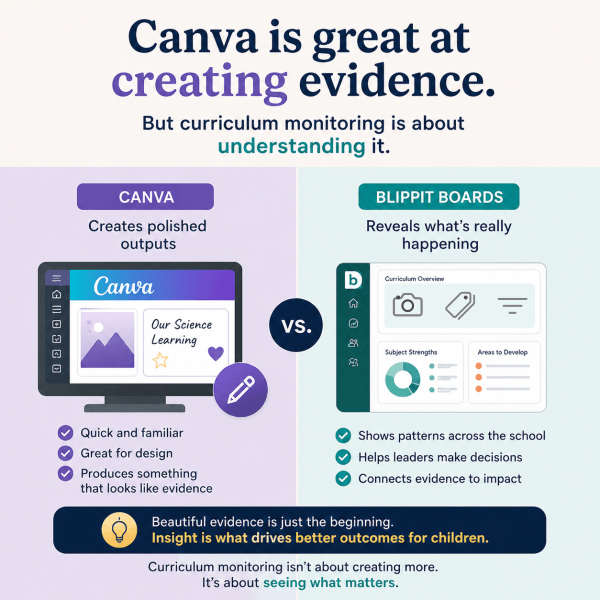
Blippit Boards is built around a different question:
Does your curriculum exist in practice the way you think it does?
Not just in individual moments. But across subjects, across year groups, and over time.
That’s what sits behind the monitoring views, the subject leader visibility, and tools like AI Curriculum Snapshot and Reflect - not more outputs, but a clearer picture of what’s actually happening across the curriculum.
They’re not about producing outputs. They’re about making what’s happening easier to see, understand, and act on.
If you’re a head and some of this resonates, you’re not alone. Most schools move through a version of this - especially when balancing staff workload, budget, and clarity. You don’t replace one approach with another overnight. But there is usually a point where you want a clearer view of what’s actually happening beneath the surface.
If that’s where you are, you can try Blippit Boards for half a term, free. Not to prove a point. Just to see whether the question it’s designed to answer is a question you actually want answered.
Write about something from your classroom and get structured thinking back - privately, in two minutes, with no sign-up.
Try a free reflection →No account needed. Not stored by Blippit.