

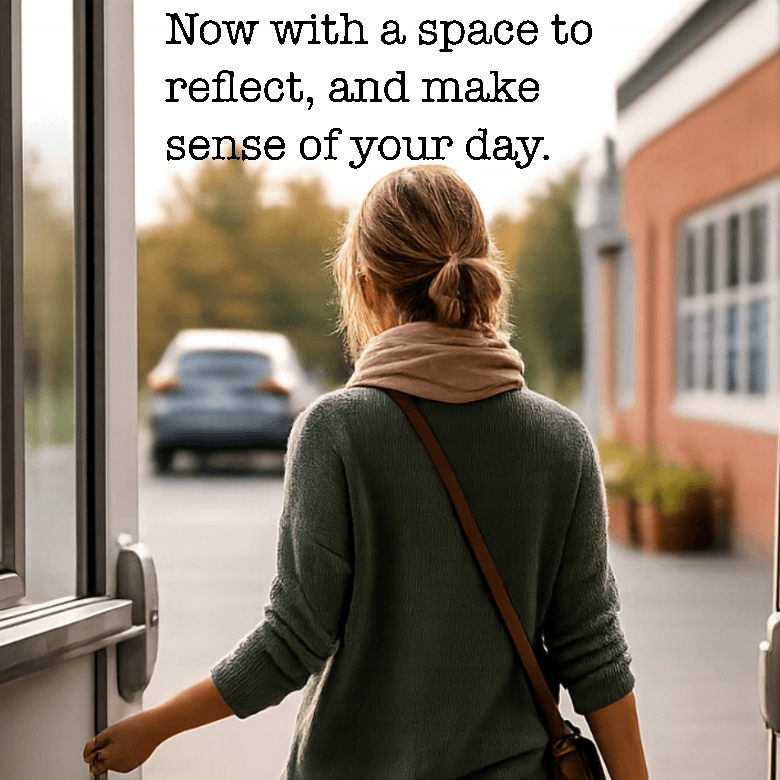
Most teachers end the day with something still on their mind from the day. A moment that went better than expected. A child who seemed disengaged and you're unsure of the whole picture as to why. Something you said in a meeting with colleagues or parents perhaps that landed differently than you intended.
These aren't idle thoughts. They're what some would call the raw material of professional growth and other, let's be honest, slightly annoying people would call 'a learning opportunity'. But the 'job' rarely gives you space to do anything with them, so most of it just passes.
Reflective practice is the habit of doing something useful with those moments, while they're still fresh enough to mean something.
If you're a teacher reading this, you probably don't need a survey to tell you how it feels right now. But the numbers are worth having, because they confirm that what many teachers experience as a personal failing is actually a systemic condition.
The Tes Teacher Wellbeing Report 2026 surveyed over 1,400 UK school staff and found that 57% report moderate to negative wellbeing at work. Only 3% say they manage to keep their work within contracted hours. 83% cite workload as their primary driver of stress, and 61% say they do not plan to stay in the profession long-term.
The report's own description of the profession is telling: a workforce that cares, at the edge of capacity.
This matters for reflective practice because the very conditions that make reflection most needed (high pressure, complex decisions, emotionally demanding work) are the same ones that leave the least time for it.
The term gets used loosely in education, sometimes to mean a formal write-up after an observation, sometimes as part of a performance management process. That version tends to feel like something done to teachers rather than for them.
The Tes report found teachers describing exactly this pressure: excessive observation and lack of autonomy were recurring themes. When reflection is tied to accountability, it stops being reflection and becomes performance.
The original idea is much simpler than that. Schon (1983) described it as pausing to examine your own experience, noticing what worked and what didn't, and using that to inform what you do next. It doesn't have to be long. It doesn't have to be structured. It just has to be honest.
Gibbs (1988) made a point worth holding onto: the value isn't in the structure itself. It's in the space it creates between experience and reaction. Experience alone doesn't lead to improvement. Reflection on experience does.
Reflective practice is linked to teacher wellbeing in the research, not because reflection is a form of therapy, but because it helps teachers make sense of their experience rather than just accumulate it.
A 2024 study from the Oxford Wellbeing Research Centre, carried out for the International Baccalaureate, found teachers reporting some of the highest levels of occupational stress and burnout of any profession. It also found that wellbeing is closely tied to professional agency, a sense of control over your own practice and experience. When teachers have space to process what happens in their classrooms, they are more likely to maintain motivation and resilience.
Providing a private, low-pressure space for reflection supports wellbeing not by adding support programmes, but by strengthening everyday professional coping and sense-making.
Most schools understand that reflection matters. Most CPD programmes mention it. But the way it tends to be structured (end-of-term reviews, lesson evaluations, professional development portfolios) doesn't match how teachers actually experience their working day.
By the time a formal reflection opportunity arrives, the moment that was still live on a Tuesday afternoon has long since passed. You're trying to reconstruct something from memory rather than actually process it.
Lamb's 2017 case study of primary school teachers in Nottinghamshire found this pattern in practice. Most teachers said they reflect regularly, but 18 out of 25 said they never ask colleagues for feedback on their teaching, primarily out of fear of being seen as inadequate. The study also found that reflection in schools is heavily driven by senior management feedback and accountability requirements, rather than genuine professional curiosity.
When reflection is tied to evaluation, teachers don't reflect honestly. And reflection without honesty isn't really reflection at all.
The research points to a few things that make a real difference.
Timing matters more than length. A few honest lines captured shortly after a moment are worth far more than a detailed account written a week later. The thoughts are still live. The feelings are still accessible. You can examine what actually happened rather than what you remember happening.
Privacy matters too. Lamb's research found directly that teachers modify what they say and write when they believe it might be read or assessed. A private space, with no line manager access and no formal record, changes what's possible. Teachers can be honest about what didn't work, which is where most of the professional learning actually lives.
Low pressure matters. The Tes 2026 report makes clear that the average teacher is already working well beyond contracted hours. If reflection feels like another obligation with a streak to maintain or a quota to hit, it won't happen. The most useful approach is something you pick up when something is still on your mind, not something with a schedule attached.
You don't need a journal, a framework, or a dedicated slot in the week. You need a reliable way to catch the thought while it's still there.
That might be a few lines typed on your phone in a free moment. It might be a voice note in the car. The format matters less than the habit of pausing, even briefly, when something is still with you.
The aim isn't to produce a polished reflection. It's to finish the thought. To get it out of your head and into a form where you can actually look at it. Often that's enough to understand it. And understanding it is usually enough to let it go.
Reflect is a feature inside Blippit Boards built for primary school teachers. It gives you a private space to capture the moments that stay with you, while they're still fresh, with no formal record keeping, no evaluation, and no data stored.
There's a free guide available that walks through the thinking behind Reflect, including the research evidence for reflective practice in teaching. If this resonates, it's worth a read.
Write about something from your classroom and get structured thinking back - privately, in two minutes, with no sign-up.
Try a free reflection →No account needed. Not stored by Blippit.