

We know that there's always a moment in a leadership meeting when someone asks the question everyone's thinking: "Is this actually going to save us time, or is it just another thing to manage?"
Never backwards in coming forwards, SLTs will ask this on demos sometimes and we've never had a much more helpful answer beyond "teachers tell us it saves them so much time and consumables" or "teachers have said they can do what they need to but more efficiently" and then showing testimonials. It's a truthful answer but it felt a bit unsatisfying. Not because we doubted what schools were telling us (we absolutely trust that) but because it didn't help *you* make a decision for *your* school, with *your* context and *your* budget constraints.
So we built a calculator in large part to help schools considering Blippit but also partly because we wanted to understand the numbers better and more transarently ourselves!
ROI - Return on Investment - is one of those phrases that sounds very corporate. It doesn't sit naturally in conversations about primary schools and curriculum monitoring but it should. Schools know full well it's just asking: if we spend money and time on this, do we get something more valuable back?
We realised that we'd never really sat down and worked it through fully. We knew schools were saving time. We knew subject leaders were less stressed and were able to use their time differently. We knew it was easier for subject leaders in particular to pull together what they needed. But how much time? What's that actually worth? And does it genuinely make financial sense?
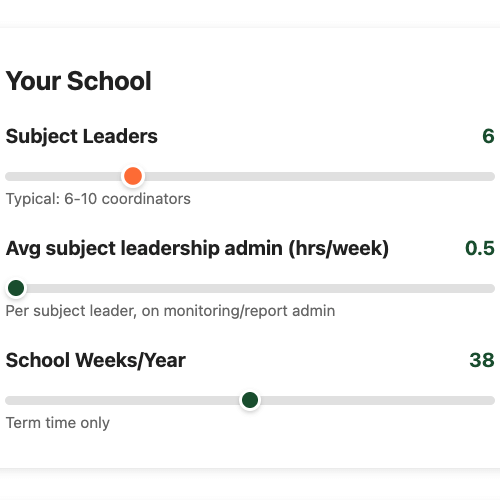
We set the calculator up with what seemed like typical figures based on conversations with schools:
- 6 subject leaders
- a time range from half an hour per week spent on monitoring-related tasks
- 38 school weeks
- £35 per hour for teacher time (salary plus on-costs)
- 50% time savings (we went conservative - some people tell us it's more like 60-70%)
With those figures as defaults, it works out at around 456 hours saved per year. Nearly 10 weeks of full-time teacher hours. We sat back and looked at that number for a while thinking "That's... a lot of time."
The catch though is that we knew the real value wouldn't show up in the numbers.
Subject leader: "I used to dread asking colleagues for photos. Now I don't have to ask because they just share moments as they happen."
SLT member: "When we wanted to show how rich our RE provision was, we didn't panic. It was just there to support our conversation. Tagged, organised and ready to go!"
Deputy: "Monitoring feels more collaborative and less like surveillance."
It's also the teachers that tell us Blippit has begun to change the feel/prep of key stage meetings - less spotlight on compliance and chasing with more time to talk about what learning looks like in subject A or B for them.
None of that goes in an ROI calculator but it matters at least as much as the time factor.
Depending on school size, Blippit Boards costs between £169 and £495 per year.
What that gets you:
- Unlimited users and devices (no per-seat charges that creep up)
- Video, photo and audio capture
- Instant PDF and Word reports
- Visual charts showing curriculum coverage
- Framework tags (SIAMS, Ofsted 2025, Eco-Schools, Values-based Education, and more)
- Support from people who've worked in schools and understand the context
- Updates based on what schools actually ask for
Most schools seem to find they've saved back the annual cost pretty quickly - less photocopying, printing, reduced hours spent preparing for meetings, less needing external monitoring support.
But whether it makes sense for your school, that's something you alone can determine.
We've always tried to be straightforward about what Blippit does and doesn't do. We pride ourselves on maintaining focus and not adding features for the sake of it. For example all of our features began as conversations with schools -literally all of them
The calculator came from wanting to give schools something concrete to work with. Not marketing promises. Not testimonials (though we're grateful to have plenty). Just: here are realistic numbers, based on typical schools, put in your context and see what it tells you.
If it makes sense, great. If it doesn't, that's absolutely fine too. We'd rather you made the right decision for your situation than pushed towards something that doesn't fit.
Calculate your school's potential savings ->
It takes about a minute. No email required. No sales call afterwards. Just numbers.
And if you want to see how Blippit actually works in real schools before making any decisions, book a demo or watch a couple of these videos instead sometime. In a demo, we'll screen-share, show you exactly how it works, answer questions, and help you think through whether it's right for your context.
We started this post talking about "is it worth it?"
But maybe is should be: "What would we do with the time we'd get back?"because that's what we keep hearing from schools who use Blippit. It's not really about the hours saved or the money. It's about what becomes possible when subject leaders have space to work more efficiently. When monitoring becomes something that helps rather than overwhelms.
The calculator gives you the numbers but you'll know if it makes sense for you in your particular setting.
---------
*Have thoughts on this? We'd genuinely love to hear them. Email us at boards@blippit.co.uk
Write about something from your classroom and get structured thinking back - privately, in two minutes, with no sign-up.
Try a free reflection →No account needed. Not stored by Blippit.